Being an Author (Reading)
At Barrs Court, our aim is to equip all children with the skills needed to become fluent, confident readers. We passionately believe that the ability to read is central to pupils’ development and their success in education and beyond. Consequently, reading is given a high priority by creating opportunities for children to become independent, enthusiastic and life-long readers. It is our mission to enable every child to experience the magic and joy of reading by introducing them to a wide range of carefully chosen texts.
Our Reading Journey
Early Reading in Reception and KS1
Phonics and Reading in Reception and Year 1:
Children in Reception and Year 1 are taught Phonics using the Little Wandle Phonics Programme. In Reception children begin to learn the sound to go with each letter, we refer to this as grapheme-phoneme correspondence (GPCs). (See Programme Overview which shows the progress of GPCs and tricky words taught each term). The progression is organised so that children are taught from the simple to more complex GPCs. In term 1 we learn single-letter sounds before learning digraphs (2 letters, 1 sound) in term 2. The children learn to orally blend words from the beginning of term 1 which gives the the skills to segment and blend words to read. Once the children have learnt the first 6 graphemes (s,a,t,p,i,n) they start to segment and blend words to read. In Year 1, pupils move onto Phase 5 which focusses on learning alternative graphemes for graphemes they learnt in Reception. Grow the code lessons help them to learn the different graphemes that make the same sound, eg ear/ ere/ eer.
Download: Little Wandle Phonics and Reading Presentation for parents
All the graphemes taught are practised in words, sentences, and fully decodable books. Children review and revise GPCs and words, daily, weekly and across terms and years, in order to move this knowledge into their long-term memory.
Daily Phonics sessions have a familiar structure with opportunities to revisit and embed prior learning, teach and practise new skills, and practise and apply their skills in the context of reading and writing sentences.
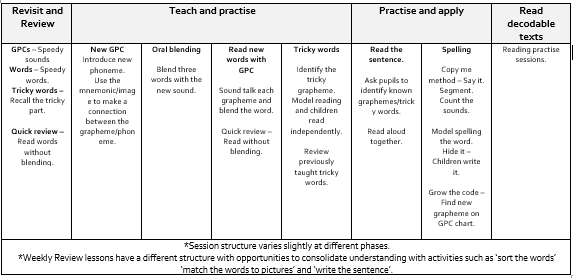
In addition to daily Phonics sessions, pupils apply their understanding during ‘Reading Practise Sessions’. Pupil’s phonic knowledge is assessed regularly and teachers are able to match decodable texts to pupils’ secure phonic knowledge. This means that pupils practise applying their understanding and do not come across words containing graphemes or tricky words etc that they do not yet know. Pupils read an appropriately levelled book within a group to a trained adult each week. Every session begins with revisiting GPCs, tricky words before reading focus words from the text and exploration of new vocabulary. The children practise decoding, reading with expression (prosody) and answering questions about the text (comprehension).
At the end of Year 1, pupils complete a statutory ‘Phonics Screening Check’ in which they are assessed on their understanding of letter sounds and decoding skills. They read real and pseudo (nonsense) words. This is a great way of practising breaking words into smaller parts and identifying known graphemes in unfamiliar words.
Reading Books:
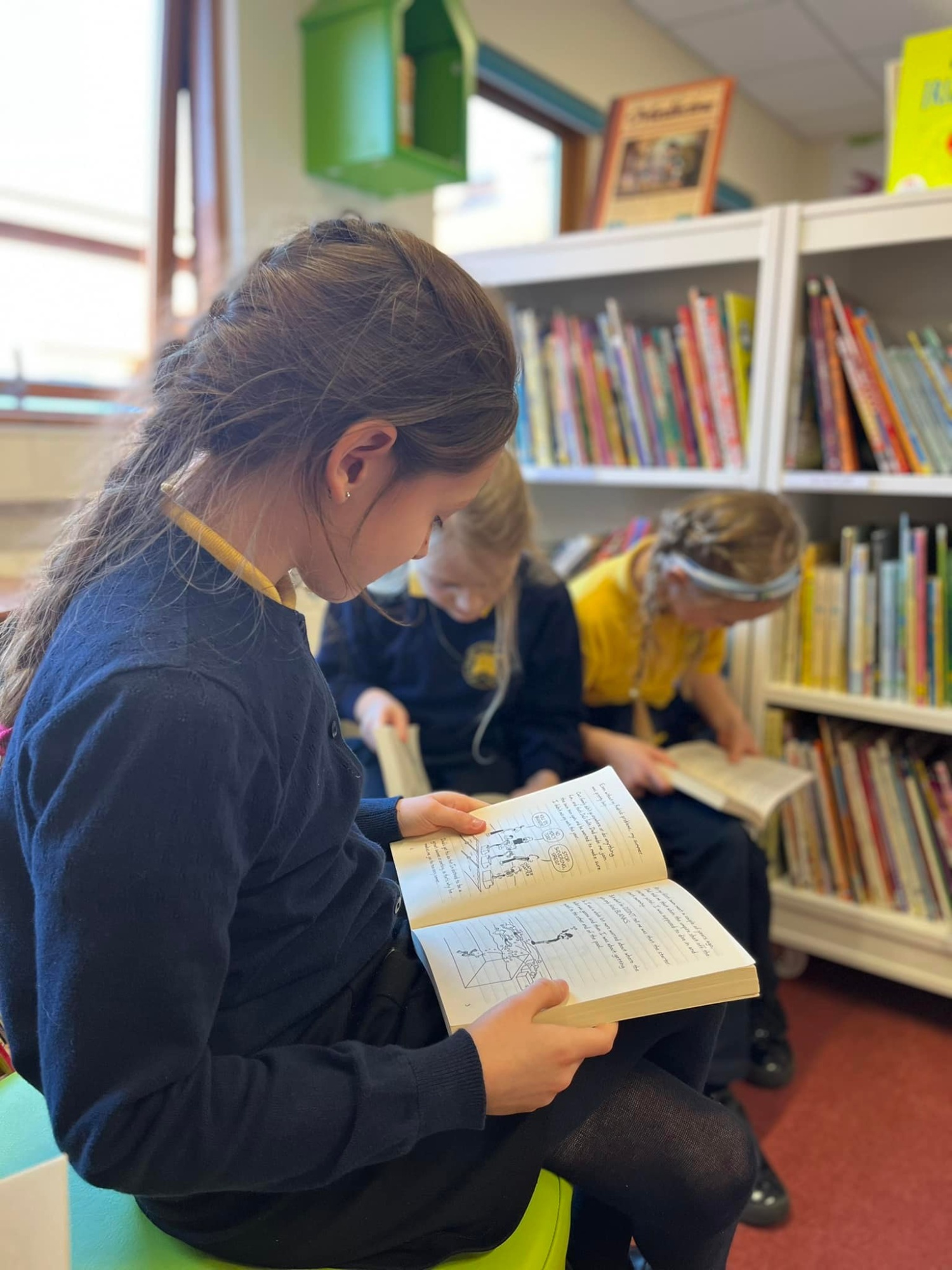
Pupils’ phonic knowledge is assessed termly and this information is used to match decodable 'Big Cat for Little Wandle' texts to each child’s secure phonic knowledge. Following their Reading Practise sessions in school, children then take home a copy of the same book to read at home. By this point, children are able to focus on fluency and comprehension and this is a fantastic celebration of the child’s reading journey that week. In addition to a decodable ‘Big Cat for Little Wandle’ book, children will take home a high-quality ‘sharing book’ from our book shelves to enjoy reading with family members at home.
Whole Class Reading
As we are part of the Mosaic Partnership Trust, we follow the Mosaic Reading Framework. This framework has been developed with reading leaders from across our schools and enables us to have a shared, common language and practice around the teaching of reading.
Reception: Talk Through Stories
Talk Through Stories is an approach designed to help young children develop language, comprehension, and vocabulary through daily, structured, story time sessions. This approach builds a strong foundation in language and literacy and supports children to develop crucial speaking and listening skills. The key elements of this approach are:
- Story-Based Learning: Children engage deeply with a high-quality picture book over the course of a week or more.
- Repetition and Discussion: The same story is read multiple times, with daily discussions to build understanding and confidence.
- Vocabulary Development: Key words from the story are explicitly taught and reinforced through conversation and play.
- Oral Language Skills: The focus is on talking. Children are encouraged to describe, explain, and retell parts of the story using new vocabulary.
- Comprehension Focus: Teachers guide children through the narrative structure, character motivations, and key themes.
Whole Class Reading Year 1 – The Scaffolded Read
As well as our Little Wandle Phonics sessions and our ‘Practise Reading’ sessions, children are also taught reading through a daily ‘Scaffolded Read’. Scaffolded reading is a structure for teaching reading that is designed to give Year 1 children plenty of decoding practice through repeated reading to begin to build fluency. This provides opportunities for children to experience different types of reading; adult modelling reading, children choral reading, reading in pairs, individual reading and time for discussion using a decodable book using GPCs already known to children. This approach also introduces Year 1 children to some of the routines of whole class reading that are used from Year 2 to Year 6.
Whole Class Reading Year 2 – 6
Reading for Years 2 to 6 is taught through 3 different Reading lesson types depending on year group. The following timetable outlines which lesson type is taught when for each year group and ensures that children get a balance of reading instruction and opportunity across the week:
|
|
Monday |
Tuesday |
Wednesday |
Thursday |
Friday |
|
Reception |
Phonics Talk Through Stories |
Phonics Talk Through Stories |
Phonics Talk Through Stories |
Phonics Talk Through Stories |
Phonics Talk Through Stories |
|
Year 1 |
Phonics Scaffolded Read |
Phonics Scaffolded Read |
Phonics Scaffolded Read |
Phonics Scaffolded Read |
Phonics Scaffolded Read |
|
Year 2 |
Phonics (until scheme completed) Fluency Read |
Phonics (until scheme completed) Fluency Read |
Phonics (until scheme completed) Fluency Read |
Phonics (until scheme completed) Fluency Read |
Phonics (until scheme completed) Extended Read |
|
Year 3
|
Fluency Read |
Extended Read |
Fluency Read |
Extended Read |
Fluency Read |
|
Year 4
|
Fluency Read |
Extended Read |
Fluency Read |
Extended Read |
Close Read |
|
Year 5
|
Fluency Read |
Extended Read |
Close Read |
Extended Read |
Close Read |
|
Year 6
|
Fluency Read |
Extended Read |
Close Read |
Extended Read |
Close Read |
As well as these sessions, we utilise our fluency assessments to decide if extra fluency sessions are required for particular cohorts. These are in addition to the timetable above.
The following is an overview of each of our Reading lesson types:
Fluency Read:
Fluency Reading is a structure for teaching reading that is designed to target children’s reading fluency through successful decoding practice and repeated reading. We believe that fluent decoding is essential as it allows us to understand what we read. Through regular fluency instruction and practise, we aim for our children to gain accuracy, automaticity, and appropriate prosody in word reading, which frees up their brain to focus on lifting the meaning from the page through connecting words and sentences across the text. Through repeated reading of texts children also observe the modelling of fluent reading by our teachers and then explicitly practise it.
Extended Read:
The Extended Read is a structure for teaching reading that is designed to give children plenty of experience of the written English Language. Extended Reading involves prolonged engagement with a longer text and focuses on the development of fluency, word knowledge, background knowledge and text knowledge through exposure to a text. The aim of an Extended Reading session is for children to build their reading stamina and establish basic sense and meaning of the text. Through the careful selection of high-quality texts, we also endeavour to foster a love of reading for pleasure in these sessions.
Close Read:
Close Reading is a Reading lesson that is designed to engage children in deeper exploration of texts. The aim of Close Reading is to carefully consider the ways authors use language and the impact that this language has on different readers. Through the discussion of texts, children are encouraged to see that texts can be interpreted in different ways and that these interpretations can be discussed and analysed.
Additional Support and Assessment of Reading
Reception and KS1:
In Reception and KS1, pupil progress is carefully monitored using Little Wandle Phonics assessments, Phonics Screening assessments, and teacher assessment during lessons. Little Wandle ‘Keep up sessions’ are used to address gaps in children’s phonic knowledge or support children developing specific skills such as blending, chunking, tricky word recognition. These are either group or individual sessions dependent on the focus. Precision teaching is also used to develop fluency and confidence in recognising GPCs and tricky words. Short daily sessions are tailored to the needs of individual pupils.
Phonics support in KS2:
In Year 3 and 4, children at risk of falling behind follow the 'Little Wandle Rapid Catch Up Programme' which addresses gaps in Phonic knowledge and provides opportunity to read decodable texts during Reading Practise Sessions. These pupils are assessed regularly to monitor progress carefully and these sessions aim to help pupils make accelerated progress.
Extra Readers (1:1)
Teachers identify children who will benefit from additional 1:1 reading opportunities in school and we particularly focus on our disadvantaged children. Our teaching assistants and trained volunteers read with these children on a weekly basis.
Those not meeting the expected standard of the Phonics Screening Check: The children who did not pass the Phonics Screening Check are assessed regularly. Interventions are implemented for those children who are not proficient at word reading (across the school).
Assessment of Fluency:
Children’s fluency is assessed by listening to children read from an age-appropriate text and measuring the number of words they read correctly in 1 minute. From year 2 to year 6, fluency assessments are undertaken 3 times per year with all children that are no longer working on the school’s phonics programme. As a Trust, we have selected texts from ‘Collins Assess Reading Fluency’. Interventions are implemented for those children who are not meeting the expected standard in Fluency.
Reading Books:
After completion of the Phase 5 Little Wandle Reading scheme, children's reading fluency and pace is assessed in order to identify an appropriate book level. Children progress through Purple, Gold, White, Lime, Cooper and Topaz book bands. They read Big Cat fiction/non-fiction books that help them develop stamina, fluency and facilitate opportunities to practise applying a range of reading skills. Once pupils reach the end of our banded 'Big Cat' reading books, they become a 'Rainbow Reader'. These are carefully chosen early chapter books which provide a manageable progression from book banded books to ultimately becoming a 'free reader'.
Reading at Home
We encourage regular reading at home,children are asked to read five times per week as part of their home learning.
Reading for Pleasure
We know that children with positive attitudes towards reading are more likely to read at or above their expected age. In addition to this, children who read for pleasure make significantly more progress in vocabulary, spelling and maths than children who read very little. Therefore, reading for pleasure is very much promoted across our school and we aim to encourage a life-long love of reading.
At Barrs Court, every class reads their own carefully chosen, high-quality ‘class book’ in addition to the book they are reading to inspire their writing outcomes and their book for their Whole Class Reading lessons. All classes read this 'reading for pleasure book' at the same time of the day and children look forward to this daily, dedicated reading time.
We also celebrate World Book Day annually and children have the opportunity to participate in regular reading events, book sales and community library visits.
Our School Library
We are very proud of our library which is well-stocked with a vast range of high-quality texts and is run by our librarians in Year 5. Every class in school is encouraged to book a slot in the library on a regular basis so that the children can peruse the shelves and take a book home to read themselves or share with an adult. We aim to update our books regularly so that our children can access a wide range of modern fiction and non-fiction and foster an interest and love for books.