Handwriting
By the end of Reception, children should be able to hold their pencil with correct pencil grip, form lower‑case letters beginning at the correct starting point and follow the correct direction. They should be beginning to form capital letters correctly.
We support the children to:
• use the correct pencil grip
• know and follow the correct starting point for each letter
• form letters accurately with the correct orientation
• know the families of letters to help starting points and direction
• write capital letters correctly
• reinforce the link between letters and sounds.
The ‘Ready to write’ checklist: the four Ps
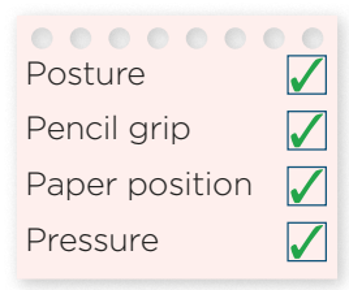
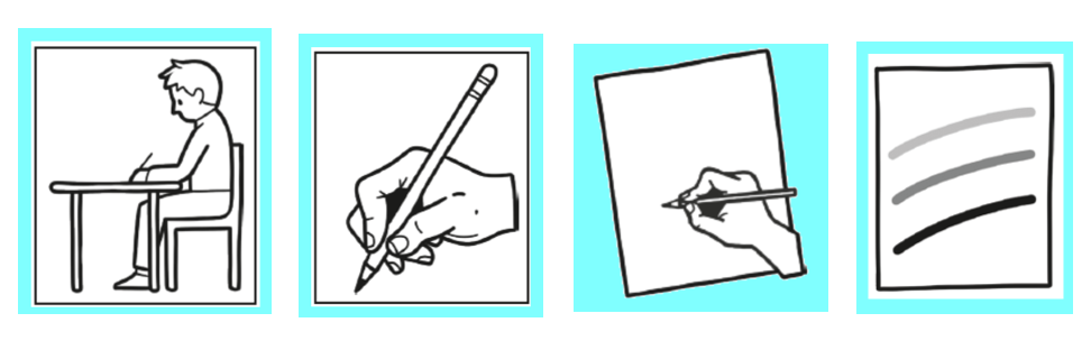
The routine of sitting correctly, picking up the pencil and holding it effectively, tilting the paper and applying appropriate pressure starts from the very beginning of the Reception year when the children practise with patterns. The routine quickly becomes embedded and automatic and good habits are formed nice and early!
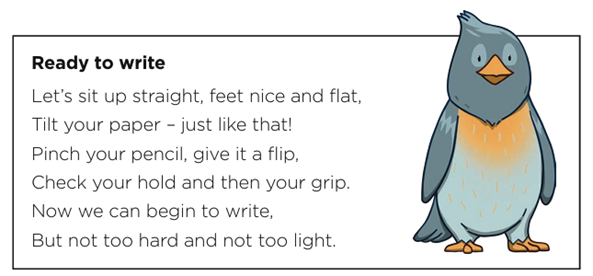
The children are reminded of the four Ps before beginning to write until it becomes automatic. The ‘Ready to write’ rhyme (to the tune of Twinkle, Twinkle, Little Star) helps to embed the discipline of the four Ps.
The Reception year consists of the following handwriting units:
|
Autumn term |
Unit 1: Practising patterns |
The children are prepared for letter formation through carefully planned motor development activities and practice of patterns. They develop the correct pencil grip, develop pressure on the page and the flow of writing. Children will practise the different types of strokes and curves they will need to use in letter formation, including horizontal and vertical lines, up and down curves, crosses and zig‑zags. |
|
Unit 2 – 5: Lower case letters |
Once the children have completed the Unit 1 lessons, learned how to hold their pencil correctly and can demonstrate control with tracing over and copying a pattern, they can begin Unit 2. In Units 2 to 5, letters are taught in families based on similar movement patterns, starting with curly letters, followed by long letters, bouncy letters and ending with zig‑zag letters. |
|
|
Spring term |
Unit 6: Capital letters |
Unit 6 introduces capital letters and provides further practice of lower‑case letters. Capital letters are taught at this early stage to help children to form them correctly and prevent bad habits. It will help their recognition of capital letters when reading, aid name writing and provide the foundations for writing sentences with a capital letter. |
|
Summer term |
Unit 7: Digraphs and trigraphs |
The final unit for Reception embeds learning by practising lower case letters in digraphs and trigraphs, and words containing these. Practising letter formation in this way provides a useful link to phonics lessons and can help with digraph/trigraph recognition although the focus stays firmly with handwriting within handwriting lessons. |
Handwriting lessons
Children complete the work for each unit in Little Wandle workbooks. They only ever write in their workbook within a focussed handwriting lesson in a small group led by the teacher or a trained teaching assistant. This is to ensure children are closely monitored and any incorrect starting points/ letter formation can be picked up. They follow the ‘Ready to write’ checklist (the 4 p's).
Once unit 1 is complete, the children form 3 letters each week. Handwriting lessons last approximately 10-15 minutes and start with practice of the previous day’s letter. The sound each letter makes is referenced but the focus of the lesson remains clearly on handwriting. The Little Wandle formation phrase is used to aid correct formation (see formation rhymes attachment below).
Additional practise
The provision allows for all children to practise writing outside of handwriting sessions following a multi-sensory approach. For example, making the patterns with chalk, paint, sand or playdough. Writing materials are readily available to the children in the provision at all times and Little Wandle visuals are around the classroom to serve as reminders of correct letter formation.
Those children needing additional support with fine motor skills and letter formation will be part of adult-led intervention groups. Any additional handwriting is done with a pencil on lined paper or on Little Wandle practise sheets.